Friday, November 20, 2020

Moab Dinosaur Tracks

Moab, Utah, is Dinosaur Central. We got down there again in October, despite the pandemic (Moab is under mask orders, and people were pretty good about social distancing on trails), and visited a few more dinosaur tracksites.

The Moab Area Travel Council has great info on area dino attractions (there are many). Descriptions of how to find the tracks are from their site.

Poison Spider Tracksite:

From the center of Moab, travel north on Hwy 191 for 5.9 miles and turn left on Hwy 279. Continue 6 miles to the Poison Spider trailhead. Parking lot is up on the top of the hill.


From the parking lot there is a short hike up the hill to a spot where a large slab has fallen off its opposite, showing theropod (3-toed dinosaur) tracks. The upper face has indentations from the footprints, while the lower face has raised molds where sediment filled in the actual tracks and then fossilized. The tracks were left by small (turkey-sized) and large (5’ tall at the hip) two-legged, meat-eating dinosaurs walking along a lakeshore 190 million years ago in the Jurassic.

The upper face, with the direct footprints.

Detail of the footprints.

The lower face, which is actually the rock layer which overlaid the tracks.


Willow Springs Tracksite:

From Moab, go north on Hwy 191 for 12 miles. Turn right onto the Willow Springs Road, off US Highway 191. 1.4 miles – take the left fork to Willow Springs. 1.7 miles – stay right on the main road and continue straight towards the Klonzo Trails area. 2.9 miles – stay right. 3.4 miles – arrive at tracksite.


Be cautious driving to this site; the unpaved road crosses a large sandy wash that will be dangerous after rains.


This is an older exposure, so some of the tracks are fairly weathered, but they are still easy to see. There are tracks from theropods (two-legged meat eaters), sauropods (big long-necked herbivores), and ornithopods (smaller herbivores). The tracks date to 165 million years ago.

Sauropod track

Trackway with geologist for scale.

Theropod track

Two crossing trackways


Bull Canyon Overlook Tracksite:

From Moab, go north on US Hwy 191 for 2.5 miles to the intersection of UT-128 (River Road). Turn right and head east 15.5 miles. At the La Sal Loop Road intersection (turn to Castle Valley) turn right and continue 10.7 miles. Continue on this road (FR207), do not follow the La Sal Loop Road signs when they turn right (southwest). Continue 5.4 miles passing the signs for Fisher Mesa. Approximately ½ mile beyond the Fisher Mesa turn park in the lot on the left (northeast) just before the road turns to dirt.


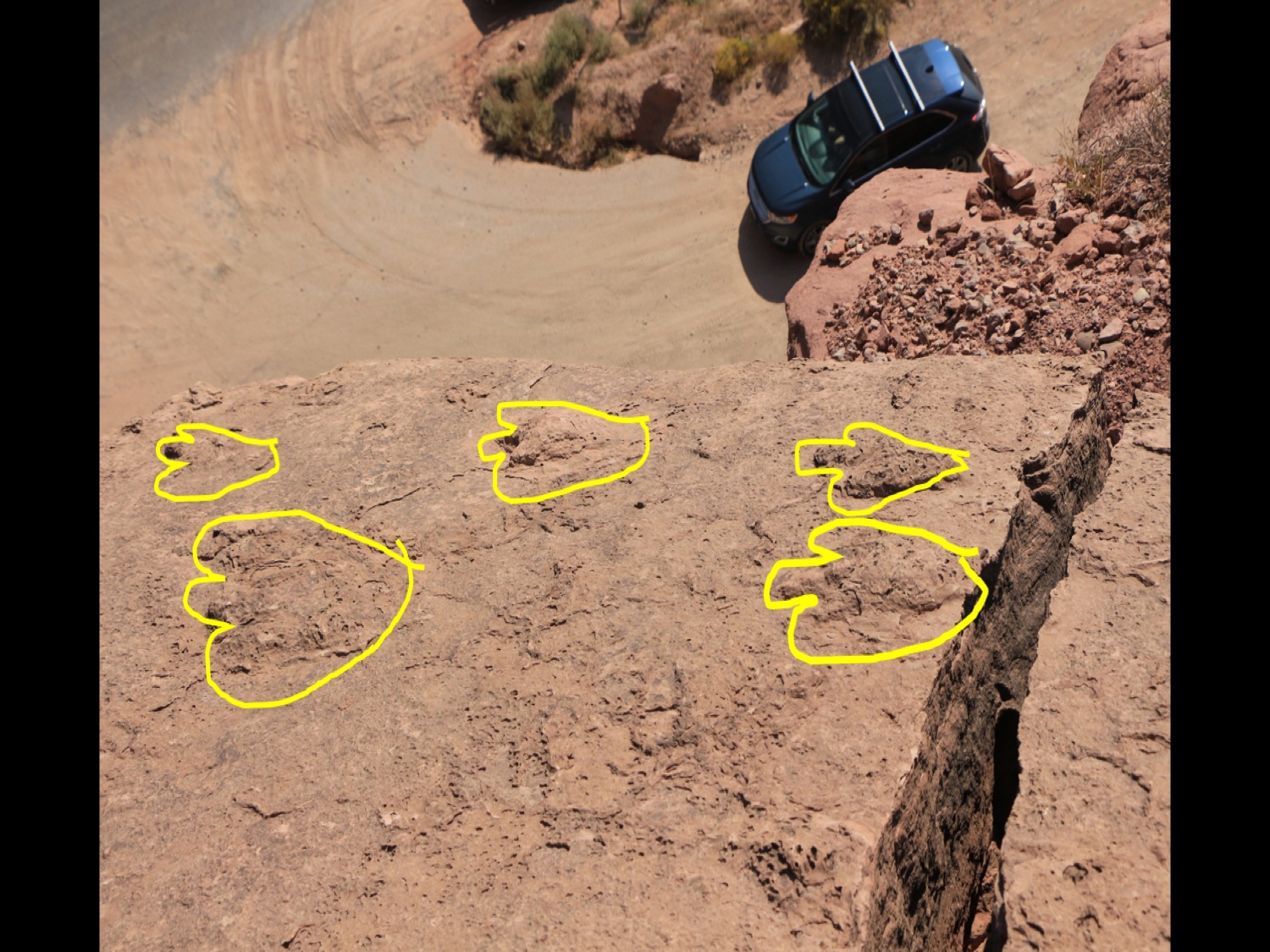
This site is up in the forested mountains of Manti-La Sal National Forest. Getting there is over an hour’s drive, but it’s worth it. The short trail is immediately adjacent to the parking lot. Some of the tracks are on the top of a thousand-foot cliff, making it look like the huge dinosaur just ran straight off the cliff to plummet to his doom. Of course, the landscape was different 200 million years ago—he walked along a sandy shore, and only later did the rocks uplift.

It looks like this big theropod just ran right off the cliff.

Theropod track (huge!) with my foot for scale.

Big trackway; each track is about four feet apart.


Sunday, October 25, 2020

Antarctic Dinosaurs

Antarctic Dinosaurs


If you get a chance to see this traveling exhibit, do so! It was developed by the Field Museum in Chicago and the Natural History Museum of Los Angeles. It is currently in residence at the Natural History Museum of Utah.


The whole idea that dinosaurs once stomped around Antarctica sort of blows my mind. Of course, it was warmer in the Jurassic and Cretaceous, but it was still dark for three months of the year. This exhibit features discoveries from various Antarctic expeditions over the last century, with techniques, equipment, video footage, reconstructed critters, and mounted skeletons.


Okay, this doesn't look like much but it's a fossil tree, Glossopteris. The ill-fated Terra Nova expedition of 1910-1913 carried 40 pounds of fossils along even as they were dying of exposure and starvation, because of the importance of these fossils. This tree was spread across Pangea and proves continental drift--Antarctica was once attached to South America, Africa, and Australia.


Reuniting Pangea

Kryostega skull


Posing with Antarctosuchus, a really big carnivorous amphibian (245 million years ago)
 
Smiling Antarctosuchus

Lystrosaurus, a proto-mammal that survived the end-Permian mass extinction

Cryolophosaurus (cryo = ice, lopho = crest, saurus = lizard) had a funny crest crosswise across its forehead. It's thought that they used it for species signaling to mates or rivals.


Cryolophosaurus

Me and my pal, Cryo

Cryolophosaurus lived in Antarctica ~190 million years ago. It wasn't as cold then, but still chilly and dark for three months of the year.

CT scan of the skull reveals the braincase and size/shape of brain regions.


"Sauropodomorph A" hasn't officially been named yet but was an early version of long-necked dinos.


Jumble of "Sauropodomorph A" bones that are too fragile to extract from the stone matrix, but they were CT scanned and then...


...3D printed from the CT scan to reconstruct the skeleton.


Monday, August 31, 2020

Fossil Teeth

Fossil Teeth

A big part of my "real" job as a veterinarian is dentistry, so I tend to be a little obsessed with teeth of extinct and extant species.

From the Natural History Museum of Utah

Mammuthus columbi, Columbian mammoth

Smilodon fatalis, the saber-tooth cat

Bison latifrons, Giant bison

Canis dirus, the dire wolf, a very good pupper

Paramylodon harlani, Giant sloth

Uintatherium

This is just the right front part of the maxilla of Arctodus, the giant short-faced bear. That canine tooth is 2-3 inches long. Unlike modern bears, these guys were built for running!

Top = Mammut americanum, American mastodon
Bottom = Mammuthus sp., mammoth
Interestingly, when people first found mastodon teeth, with the big crowns as opposed to the flat grinding surface of mammoth (and modern elephant) teeth, they thought mastodons were carnivores (and thought they were still alive). That's just what 2020 America needs--carnivorous elephants.


From the Museum of Ancient Life

Dimetrodon, my favorite not-a-dinosaur (they lived way before the dinosaurs, and were synapsids--proto-mammals)

Another smiling Smilodon

Basilosaurus, a proto-whale

Mammoth jaw


Sunday, August 9, 2020

Bone Cancer in a Dinosaur

Centrosaurus with Osteosarcoma :(

A new report out documents osteosarcoma, a painful bone cancer, in a Centrosaurus specimen from Alberta (a four-legged horned herbivorous dinosaur related to Triceratops). Smithsonian article here.

Cool paleoart by @usikpaleoart on Twitter

Tuesday, May 19, 2020

Book shopping

Just as carbs consumed during quarantine don’t count, books purchased during quarantine don’t count! Here’s my latest stash, supporting three local indie bookstores.


Sunday, May 17, 2020

Public Health

Hey, just a reminder. Veterinarians are trained in virology, immunology, and epidemiology. The promotion of public health is literally in our oath. Veterinarians have been fighting non-COVID coronaviruses for decades, such as Feline Infectious Peritonitis (FIP). I have been studying and treating infectious diseases for 27 years. This IS my lane. Wear your mask and social distance, regardless of what the politicians say!


Monday, April 6, 2020

Volunteering in quarantine

NHMU is closed but digitization is a way to still volunteer (sitting on the couch with the dog, and wearing jammies)! Transcribing paleontology catalog notes from the early 1900's!