Showing posts with label museums. Show all posts

Sunday, October 24, 2021

Proboscideans are Cool

I turned 50 last week and for my birthday I wanted to go to natural history museums. I’m a museum nerd, a paleontology nerd, and the Pleistocene is my favorite time period, so I planned a trip to the Los Angeles area. I told my family that they could come but they had to be willing to be dragged to museums and weren’t allowed to complain about it. So I planned a four-day weekend and we saw four museums (plus an aquarium). The museums were the La Brea Tar Pits/George C. Page Museum, the Western Science Center, the San Bernardino County Museum, and the Natural History Museum of Los Angeles County. More on the museums themselves later.


California is a pretty awesome place for paleontology. The state mandates that any paleontological artifacts encountered during construction be reported and dug up by a salvage paleontologist. With all the construction that happens in that state, this means a lot of specimens for science. The finds in the LA area are Pleistocene, so that means lots of megafauna for museums.


I love proboscideans—the elephant family (proboscis = nose). There are a lot of extinct elephant species, besides the two extant species, including four-tuskers, shovel-tuskers, and straight-tuskers. The proboscideans we met in LA were:


At La Brea:

American mastodon (Mammut americanum)


Columbian mammoth (Mammuthus columbi)


Comparison of lower jaws (mandibles) of Columbian mammoth and pygmy mammoth


Pygmy mammoth (Mammuthus exilis) – “exilis” because they were exiled onto small islands off the Californian coast. Island populations are weird because big animals tend to evolve smaller (because of limited resources) while small animals tend to evolve big (because of lack of predators). These wee little mammoths lived on Santa Rosa, San Miguel and Santa Cruz islands up to 10,000 years ago.

You could keep a pygmy mammoth as a backyard pet!


At Western Science Center:

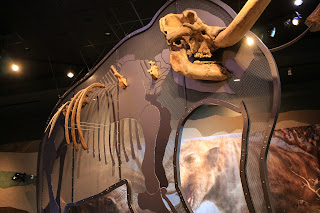
Pacific mastodon (Mammut pacificus) – this holotype of a new species is nicknamed “Max.” The Pacific mastodons are larger than the American mastodons, and none have tusks in the lower jaw (many American mastodons do).


Columbian mammoth (Mammuthus columbi) “Xena”

"Xena" in front, "Max" behind


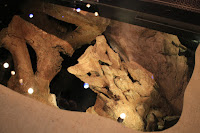
I really like how Western Science Center presents its fossils. One of the complaints you hear from science deniers is that “dinosaur bones are all replicas,” implying that they are fake, just made-up fantasies like Godzilla. Yes, most (but not all) mounted skeletons are replica casts; the fiberglass casts are much sturdier and much lighter weight, and leave the actual bone free for study. At Western Science Center, the mastodon and mammoth are mounted with a metal silhouette and casts of the bones put in the anatomical location, and then in the base of the mount under glass are the actual bones themselves, nestled in sand to support the fragile bones. You can see the real bones, with the real glue that preparators used. Max’s pelvis is too fragile to cast, so only the real bones are present under the mount.

Max's femur. You can see the preparation glue.
Max's left ribs
Xena on the left and Max on the right. The mounted skulls and bones are casts, and the original bones are in the glass-topped recesses in the base of the mount, with the skulls in separate glass cases.

Xena's fibula and femur
Max's pelvis, which is too fragile to cast so the mount doesn't have a pelvis.

At San Bernardino County Museum:

American mastodon (Mammut americanum) – they weren’t actually fluffy but it’s so cute! A fluffy dire wolf threatens the fluffy mastodon from the second floor.


At the Natural History Museum of LA County:

American mastodon (Mammut americanum)


Sunday, October 25, 2020

Antarctic Dinosaurs

Antarctic Dinosaurs


If you get a chance to see this traveling exhibit, do so! It was developed by the Field Museum in Chicago and the Natural History Museum of Los Angeles. It is currently in residence at the Natural History Museum of Utah.


The whole idea that dinosaurs once stomped around Antarctica sort of blows my mind. Of course, it was warmer in the Jurassic and Cretaceous, but it was still dark for three months of the year. This exhibit features discoveries from various Antarctic expeditions over the last century, with techniques, equipment, video footage, reconstructed critters, and mounted skeletons.


Okay, this doesn't look like much but it's a fossil tree, Glossopteris. The ill-fated Terra Nova expedition of 1910-1913 carried 40 pounds of fossils along even as they were dying of exposure and starvation, because of the importance of these fossils. This tree was spread across Pangea and proves continental drift--Antarctica was once attached to South America, Africa, and Australia.


Reuniting Pangea

Kryostega skull


Posing with Antarctosuchus, a really big carnivorous amphibian (245 million years ago)
 
Smiling Antarctosuchus

Lystrosaurus, a proto-mammal that survived the end-Permian mass extinction

Cryolophosaurus (cryo = ice, lopho = crest, saurus = lizard) had a funny crest crosswise across its forehead. It's thought that they used it for species signaling to mates or rivals.


Cryolophosaurus

Me and my pal, Cryo

Cryolophosaurus lived in Antarctica ~190 million years ago. It wasn't as cold then, but still chilly and dark for three months of the year.

CT scan of the skull reveals the braincase and size/shape of brain regions.


"Sauropodomorph A" hasn't officially been named yet but was an early version of long-necked dinos.


Jumble of "Sauropodomorph A" bones that are too fragile to extract from the stone matrix, but they were CT scanned and then...


...3D printed from the CT scan to reconstruct the skeleton.


Monday, August 31, 2020

Fossil Teeth

Fossil Teeth

A big part of my "real" job as a veterinarian is dentistry, so I tend to be a little obsessed with teeth of extinct and extant species.

From the Natural History Museum of Utah

Mammuthus columbi, Columbian mammoth

Smilodon fatalis, the saber-tooth cat

Bison latifrons, Giant bison

Canis dirus, the dire wolf, a very good pupper

Paramylodon harlani, Giant sloth

Uintatherium

This is just the right front part of the maxilla of Arctodus, the giant short-faced bear. That canine tooth is 2-3 inches long. Unlike modern bears, these guys were built for running!

Top = Mammut americanum, American mastodon
Bottom = Mammuthus sp., mammoth
Interestingly, when people first found mastodon teeth, with the big crowns as opposed to the flat grinding surface of mammoth (and modern elephant) teeth, they thought mastodons were carnivores (and thought they were still alive). That's just what 2020 America needs--carnivorous elephants.


From the Museum of Ancient Life

Dimetrodon, my favorite not-a-dinosaur (they lived way before the dinosaurs, and were synapsids--proto-mammals)

Another smiling Smilodon

Basilosaurus, a proto-whale

Mammoth jaw


Monday, April 6, 2020

Volunteering in quarantine

NHMU is closed but digitization is a way to still volunteer (sitting on the couch with the dog, and wearing jammies)! Transcribing paleontology catalog notes from the early 1900's!


Sunday, January 26, 2020

DINOFEST

 It's DINOFEST at the Natural History Museum of Utah!

Allosaurus jimmadseni -- new species just described two days ago!

Me and baby Utahceratops

“Down with Meteors”
“See New Dino Species”
“Antarctic Dinosaurs”