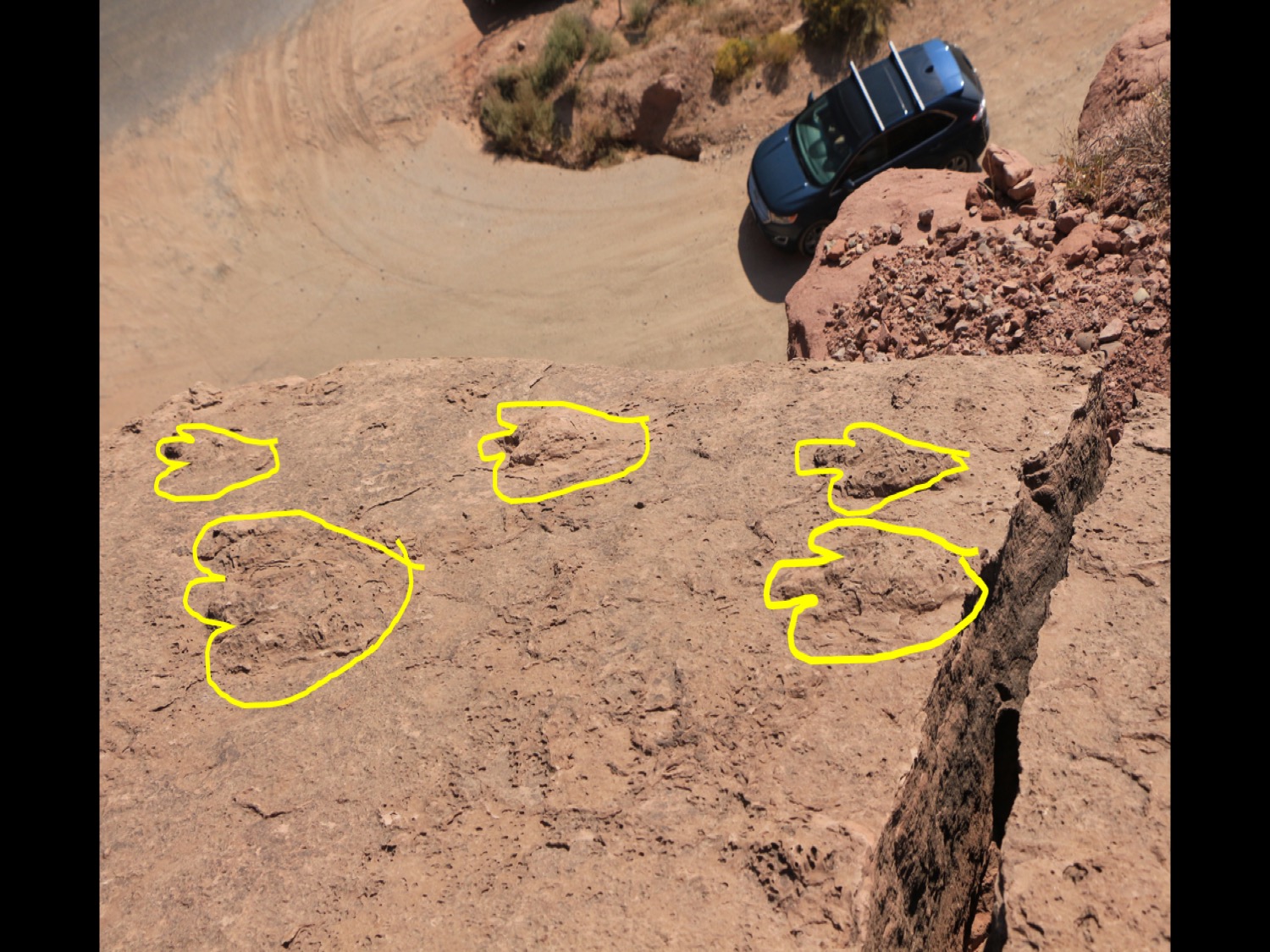
The Dinosaur Diamond is named for a roughly diamond-shaped path including Vernal, UT, Grand Junction, CO, Moab, UT, and Price, UT, as its corners. All feature dinosaur attractions, including museums, quarries, and tracksites. We did the loop in six days, but you could do fewer or more days. The articles I read before the trip mostly talked of going counterclockwise around the loop, starting at Moab. We decided to go clockwise, starting in Vernal.
 |
| Map from National Geographic article |
Vernal, Utah
Vernal folks seem pretty proud of their dinosaur history. There’s a large pink roadside sauropod holding a sign that says, “Vernal: Utah’s Dinosaur Land,” as well as a large green roadside T. rex wearing a cowboy hat.
Summer hours (7 days a week) 9-5
The museum features an articulated Diplodocus in the lobby, extensive fossils arranged by geologic era, and an outdoor garden of life-size prehistoric beasts. Fossils include large Uintatheres (big Eocene saber-toothed herbivorous mammals), trilobites, ammonites, and a whorl of teeth from a prehistoric chainsaw shark. Life-size reconstructions include a mammoth with hemp hair, Edaphosaurus (not a dinosaur but a sail-finned mammal-like synapsid), orange Utahraptor, Permian-era therapsid Moschops (like a cow-frog combination, related to mammals), and a derpy T. rex. The science is good overall, although some of the life-size outdoor beasts date from the fat, lazy, tail-dragging genre of dinosaur reconstruction. The museum also has a small exhibit of paintings by Ernest Untermann, with subjects from Utah landscapes to dinos to Pleistocene mammals, and a room of fluorescent minerals.
 |
| Entertaining Untermann painting (1940's-50's) |
 |
| Friendly Diplodocus |
 |
| Stegosaurus |
 |
| Geriatric Haplocanthosaurus showing significant arthritis |
 |
| Uintatherium |
 |
| Wall of Eocene fossils |
 |
| Battling Uintatheres |
 |
| Mammoth |
 |
| Protorohippus |
 |
| Sabertoothed cat, Smilodon californicus |
 |
| Ammonite |
 |
| Utahraptor |
 |
| Edaphosaurus (not a dinosaur but a synapsid like us) |
 |
| Whorl of teeth from can-opener shark, Helicoprion |
 |
| Trilobites |
 |
| Deep time |
 |
| Diplodocus in the entrance hall |
 |
| Tail-dragging Tyrannosaurus threatening Triceratops |
 |
| Derpy T. rex |
 |
| Derpy Diplodocus |
 |
| Fluorescent minerals |
Recommended for lunch or dinner; it’s right across the street from the Field House (you can see the derpy T.rex from the patio). It’s family-friendly and offers a variety of locally brewed beers, including Allosaurus Amber Ale.
(435) 781-2337
55 S. 500 E.
Vernal, Utah 84078
From Vernal, we headed east on Hwy 40 a short way to Jensen, and from there north on Hwy 149 into Dinosaur National Monument. The Monument extends across Utah and Colorado; the dinosaur parts are only in the western (Utah) portion, but there are nice views and trails in the eastern (Colorado) portion. The Monument has several campgrounds; some accept reservations, including the Green River Campground in the Utah portion, where we camped two nights.
Quarry Visitor Center
Summer hours (7 days a week) 8-6
11625 E 1500 S
Jensen, UT 84035
(435) 781-7700
Quarry Exhibit Hall
Summer hours (7 days a week) 8-5:30
The Visitor Center is a small building, with basic information, gift shop, bathrooms and water. From there, get on the shuttle bus to take you up the cliff to the Quarry Exhibit Hall. The quarry is really impressive. This bone field was discovered in 1909 by a Carnegie-financed expedition and has yielded huge numbers of bones. The building faces a wall of fossils still in place—the wall is only a portion of the original quarry, and is still full of scattered bones after specimens were removed to museums all over the world. The quarry is in the Morrison Formation, a geologic formation dating to the late Jurassic, around 149 million years ago. Dinosaurs that have been discovered include Apatosaurus, Diplodocus, Barosaurus, Camarasaurus, Allosaurus fragilis (Utah's State Fossil), Torvosaurus, and Stegosaurus. There’s also an exhibit of Allosaurus jimmadseni, discovered elsewhere in the park and named after Utah’s first state paleontologist, the late Jim Madsen.
 |
| Jumbled bones |
 |
| Camarasaurus |
 |
| It's difficult to convey just how huge the bone wall is |
 |
| Just a small piece of the bone wall |
 |
| Two femora, probably around five feet long each |
 |
| Nearly complete skeleton of a juvenile Camarasaurus |
 |
| Allosaurus |
Daily there is a ranger-led walking tour from the quarry back down to the visitor center (the Fossil Discovery trail is also available at all times without a ranger). The walking tour passes through geologic time, from the whitish sea-bed Stump Formation (163 million years old, with clam fossils; ichthyosaurs, belemnites, and ammonites have also been found here) to the red-grey river-bed Morrison Formation (150 million years old; with sauropod vertebrae and femur visible still in the ground) to the grey volcanic ash Mowry Formation (93 million years old; with fish scale fossils). There are also a few Fremont petroglyphs on the fossil trail.
 |
| The Quarry Exhibit Hall |
 |
| Fossil clams in Stump Formation rock |
 |
| Sauropod femur in place in the rock |
 |
| Petroglyph of a lizard |
Elsewhere in the Monument are more extensive petroglyphs: people, big horn sheep, aliens???, abstract patterns, lizards, goats, etc. Some are pictographs—painted with natural pigments—with red and orange bands on their chests.
 |
| Fremont petroglyphs |
 |
| Dude with antennae |
 |
| Pictographs |
After the second night camping in the western half of Dinosaur NM, we packed up and crossed the border into Colorado via Hwy 40. Dinosaur, CO, is a little town with more roadside dinos, including a distraught-looking Pachycephalosaurus and an aerial pterosaur skeleton. Just east of Dinosaur, turn north to go into the Colorado half of the monument, which has a nice scenic drive up to Harpers Corner. It’s a deserted stretch of road (watch out for sheep and cattle in the road), and at the end are hiking trails leading to fossil brachiopods.
 |
| Pachycephalosaurus |
 |
| Pterosaur |
 |
| On the Harpers Corner road |
 |
| Big Daddy Bull |
 |
| Harpers Corner overlook to the Green River |
 |
| Mule deer |
From Dinosaur, CO, head south to Fruita and Grand Junction via highways 64 & 139. The road goes through Canyon Pintado National Historic District, which has Fremont petroglyphs and a nice view from the aspen-covered Douglas Pass at 8268 feet.
Fruita and Grand Junction, Colorado
550 Jurassic Court
Fruita, CO 81521
(970) 858-7282
Summer hours (7 days a week) 9-5
In Fruita is the Museums of Western Colorado’s Dinosaur Journey (an awkward title, and yes, the “Museums” is plural). Dinosaur Journey is an odd place, a combination of good science and cheesy animatronic dinosaurs. It’s a good place for kids, because they can watch Utahraptor decapitating a poor sauropod, and can be spat upon with water from a Dilophosaurus (the “Jurassic Park” dino that spat venom, although there is no scientific evidence for spitting). There are also a simulated earthquake shaking floor, a water/rock damming table, and a big red box the size of a Brachiosaur heart. In the real science category, there are a cool T. rex model leg with muscles and ligaments, a front leg of Brachiosaurus that extends to the rafters, a model of Fruitadens, a teeny tiny little herbivorous dinosaur discovered nearby, and mounted skeletons of several armored dinosaurs (my favorites). When we were there, they had a special exhibit called “Horns and Frills,” featuring a number of ceratopsians, including Diabloceratops, Kosmoceratops, and Bravoceratops.
 |
| The Dino Bus |
 |
| Tyrannosaurus leg, like a giant turkey leg |
 |
| Apatosaurus femur with Allosaurus tooth marks |
 |
| Animatronic Utahraptor slaughtering a sauropod |
 |
| Brachiosaurus heart life-size |
 |
| Front right limb of Brachiosaurus; his head would be up through the ceiling |
 |
| Heliobatus radians |
 |
| Spitting animatronic Dilophosaurus |
 |
| Velociraptor, about the size of a turkey |
 |
| Pathologic fused vertebrae of Apatosaurus; he might have had a herniated disc |
 |
| Diabloceratops |
 |
| Wee little Fruitadens, about the size of a chicken |
Moab, Utah
From Fruita, head west on I-70 back into Utah then south on highway 191 to Moab. We spent three nights in Moab, staying in a rented cabin. There are a ton of things to do around Moab, so you could stay longer.
Moab itself is a trendy town full of adventure outfitters, art galleries, and coffee shops. But if you know to look, there are a lot of dinosaurs around, too.
112 West SR-313
Moab, UT 84532
(435) 355-0288
Summer hours (7 days a week) 10-6
As you come into town, you'll see Moab Giants, just north of town at the intersection of highways 191 and 313, which is also the turn-off to Canyonlands National Park and Dead Horse Point State Park. You’ll see the Tyrannosaurus reges from the road—two giant, black dinosaurs stalking the desert. Moab Giants is another curious place, a combination of solid science and Hollywood. It was started by a couple of scientists (I wonder where they got the funding) but has a very “Jurassic Park” feel.
 |
| The "Jurassic Park"-esque entrance |
 |
| T. reges visible from the highway |
The whole place is based on the premise of tracks and what we can learn from them. The conditions which are ideal for preservation of dinosaur tracks are in general not conducive to fossilization of bones, and vice versa. For example, one display shows Eubrontes tracks (the tracks have Latin names, which strikes me, a biologist, as strange). Eubrontes tracks are early Jurassic tracks of a theropod, a three-toed carnivore. One representative critter who lived in that time and place and who could have made those tracks is Gojirasaurus quayi (Gojira = Godzilla!).
 |
| Gojirasaurus track, interpretive sign, and life-size reconstruction |


The outdoor dinosaur garden features life-size dinosaur reconstructions, arranged from Triassic to end Cretaceous. Some dinosaurs are labeled, “Friendly Dinosaurs: Open Access. They love pictures and petting but do not ride or climb! They haven’t been properly prepared or trained for that”—perfect for photo ops. The reconstructions generally follow more recent science, with feathers and a lively stance, not like the dullard tail-draggers in other reconstructions. Utahraptor is particularly impressive: a seven-foot tall, feathered and clawed, menacing murderbird. At the end of garden are the two T. reges—standing underneath, you see how really big these animals were. In addition to the outdoor garden, there are a children’s play area, café, gift shop, small museum, 3D movie (pretty lame, actually, just a short history of the world from the Big Bang, but for inexplicable reasons it ends at the Permian so doesn’t even include dinosaurs). My kids’ favorite feature was the “5D Prehistoric Aquarium.” You put on 3D glasses and walk through a faux aquarium, which features seven “tanks” (i.e., screens) with animated aquatic beasts swimming about, including Dunkleosteus (giant Devonian fish with battle-axe bone plate teeth), Mosasaurus, and the big hit, Megalodon, the largest shark ever. 3D gives me a headache, but the aquarium really helps to demonstrate how large these animals were.
 |
| "Friendly Dinosaur: Open Access" |
 |
| Ceratosaurus |
 |
| Diplodocus longus mom and babies |
 |
| Gargoyleosaurus parkpinorum |
 |
| Utahraptor: seven feet of swift, agile murderbird |
 |
| Niobrarasaurus coleii |
 |
| Tyrant Lizard King |
Also in Moab is the Museum of Moab, featuring exhibits on paleontology, geology, archaeology and mining. Unfortunately, we didn’t get there this trip.
118 E. Center Street
Moab, UT 84532
(435) 259-7985
Summer hours (closed Sundays) 10-6
600 N Main Street, Moab UT
(435) 259 – 7312
Summer hours (7 days a week) 8:30 AM – 10 PM
If you like dinosaurs, you probably like rocks and fossils in general, so a must-see place in Moab is Lin Ottinger’s Rock Shop, right on the main road at the north end of town. Lin Ottinger spent a lifetime collecting fossils in Utah, and made impressive discoveries. He has a dinosaur named after him in recognition of his contributions to paleontology, Iguanodon ottingeri. His rock shop is a glorious, chaotic, eclectic assortment of stuff. We bought Utah-native picture sandstone, fluorescent aragonite, and break-your-own geodes, plus non-native aquamarine, rose quartz, and a brachiopod. There are impressive Green River Formation fish fossils, a local sauropod femur (not for sale unless you have $4.5M in cash), opalized ammonites, giant amethyst geodes, dinosaur bone fragments, dinosaur gizzard stones (some species swallowed stones to break up the fibrous plant material that they swallowed whole), skulls, and trilobites.
 |
| Lin Ottinger's Rock Shop |
 |
| Glorious assortment of stuff: skulls, Utahraptor claw, minerals, plastic dinosaurs, lanterns |
 |
| Petrified wood |
 |
| "Uranium Glass (Slightly Radioactive)" |
 |
| Radioactive uranium/vanadium compound (Moab used to be a site of uranium mining) |
 |
| I love any place with a shop dog! |
 |
| Opalized ammonites |
 |
| Green River Formation fish fossils |
 |
| Agates at sunset |
 |
| "Real, Genuine Petrified Femur from a Sauropod" |
 |
| The $4.5M bone |
The best part of Moab for a dinophile are the tracksites. There are a number of tracksites, some harder to find than others. The Discover Moab website, the Utah Geologic Survey website, and the Utah.com website have lists that overlap somewhat. We went to two tracksites, both on BLM land.
This site is approximately 23 miles north of Moab on Hwy 191. Turn right 0.6 miles past mile marker 148 as you go north from Moab. The road is labeled “North Klondike Trails” for dirt biking. Follow the dirt road for a while and go left at the fork in the road. (The right fork leads to a longer hiking trail to the "Stomping Ground" site, with different sizes and species of tracks.) Park at the tracksite parking lot and hike a short way up the hill to two adjacent tracksites. The tracks are late Jurassic, in Entrada Formation sandstone. First are about ten footprints of a sauropod (four-legged herbivore, probably Camarasaurus or Diplodocus) plodding along and turning right. Just beyond the sauropod tracks are the tracks of an injured theropod. This guy, probably an Allosaurus, was injured in the left leg, so that the tracks show a longer stride and heavier footfall with the right foot.
 |
| Three-toed theropod track |
 |
| Theropod tracks extending away |
 |
| Sauropod tracks extending away and then turning right |
The Mill Canyon site is fantastic, one of the largest tracksites from the early Cretaceous in North America. Turn west on Mill Canyon Road, about 15 miles north of Moab, and follow the dirt road about a mile to the parking lot. From the parking lot it’s just a short walk to the site, which is surrounded by boardwalks to protect the tracks. BLM has helpful signs posted to explain the tracks. This patch of green Cedar Mountain Formation rock has tracks from multiple species of dinosaur, plus slide marks of a crocodile. There are tracks from large sauropods and theropods, armored dinos, and a probable Deinonychus—think of the “raptors” from “Jurassic Park.” They have three toes on each rear foot but the inner toe has a humongous death-dealing claw on it, so they walk on only the outer two toes and hold the claw up to avoid tripping and self-impalement.
 |
| Deinonychus tracks showing only two toes |
 |
| Artist's reconstruction of all the assorted dinosaurs on that long-ago day |
 |
| Medium theropod tracks, with my feet for size reference |
 |
| BLM has done a nice job with boardwalks and signage |
 |
| Mixed ornithopod and sauropod tracks |
 |
| Visit in the morning when the shadows show the tracks |
Arches National Park is right outside of Moab (5 miles north of town on Hwy 191), and is an extremely popular park. Delicate Arch is the iconic arch (it’s on our license plates). There is a trail to the arch, 1.5 miles one-way and including a fairly steep section up slickrock, but the view at the end is worth it. If you plan to take the trail, go as early in the morning as possible to minimize crowds and risk of heat stroke.
 |
| Delicate Arch |
 |
| North Window Arch |
 |
| Double Arch |
West of Moab are Canyonlands National Park and Dead Horse Point State Park, both of which overlook the Green and Colorado Rivers. Canyonlands has three separate districts, which are not accessible from one to another. The district near Moab is called Island in the Sky, and has some impressive views from hiking trails and roadside stops.
 |
| Looks like a giant theropod track but it's the Colorado River |
 |
| Hey Flat-Earthers, you can see the curvature of the Earth! |
Price, Utah
From Moab, travel northwest on highways 191 & 6 to Price, the final corner of the diamond.
155 East Main Street
Price, Utah 84501
(435) 613-5755
Summer hours (closed Sundays) 9-5
In the town of Price is the Prehistoric Museum of the Utah State University-Eastern (formerly College of Eastern Utah). This museum is struggling for funding, but a worthwhile place to visit. There are two wings of the museum, one paleontology and the other archaeology. The paleo half features a recumbent Camarasaurus skeleton (I’m not sure if mounting was too expensive), a Utahraptor in a bizarre dancing posture, presumably the better to slice out your guts with the hind foot claw, and several large armored dinosaurs. There is an extensive collection of Cretaceous dinosaur tracks from coal mines: the footprints formed when late Cretaceous beasts tromped across fallen plant material; that plant material became coal and now the tracks are in the ceiling of coal mines, and occasionally fall on miners’ heads. The archaeology half features the paleo-Indians of this area, with Pleistocene animals including the Huntington Mammoth (Mammuthus columbi), a nearly complete skeleton of a mammoth discovered during construction of the Huntington Reservoir Dam, a dire wolf, and a really big cave bear, Arctodus simus. The museum is updating their exhibits to reflect more recent research, so I was happy to let the kids buy souvenirs to help finance the museum.
 |
| Utahraptor funky dance move |
 |
| Utahraptor funky dance move sculpture |
 |
| Dimetrodon (not a dinosaur but a synapsid) had extra teeth at the back of the palate! |
 |
| "Pet a dinosaur" Apatosaurus femur |
 |
| Allosaurus vertebra punctured by a Stegosaurus tail spike |
 |
| Reclining Camarasaurus |
 |
| Cretaceous tracks from Utah coal mines |
 |
| Huntington mammoth |
 |
| Peloroplites cedrimontanus, an armored herbivore bigger than my Subaru |
 |
| How science changes to incorporate new discoveries: this charming geologic time scale from 1965 doesn't have the Ediacaran period (pre-Cambrian), and the Cretaceous dinosaurs are of the fat, lazy, tail-dragging era. |
And the final stop on the road trip:
Summer hours 10-5, Sundays 12-5
BLM office in Price, Utah at (435) 636-3600
South of Price is the Cleveland-Lloyd Dinosaur Quarry, the largest assemblage of fossilized dinosaurs ever found. There are a number of late Jurassic species represented, including carnivores Allosaurus, Torvosaurus, and Ceratosaurus, and herbivores Camarasaurus, Barosaurus, and Stegosaurus. The quarry is called a “predator trap,” because the number of predators, especially Allosaurus, outnumbers the herbivores (think of a wolf stalking a herd of deer; normally the herbivores outnumber the carnivores). There have been so many Allosaurs of different ages studied that the growth cycle of the species is very well understood. The quarry is in the middle of nowhere; we came south from Wellington, which had poor signage (download the route from Google Maps), but it would probably be easier to come east from Elmo. You’ll take a number of dirt roads, seeing no one but sheep and goats, but finally you’ll see a gate with metal Allosaurus cutouts. The site has a small but nice visitor center, a picnic area surrounded by boulders as big as cars, a self-guided rock walk with fossils, and the quarry itself, which has some bones still in place in the ground, as well as casts. In the visitor center, a group of metal chickens gaze up in adoration at the mounted Allosaurus, awaiting their instructions for the Theropod Revolution. (For more on the Theropod Revolution, follow SUE the T. rex on Twitter!)
 |
| The Middle of Nowhere |
 |
| Gates to the quarry |
 |
| Allosaurus leading the Theropod Revolution |
 |
| Modern theropods |
 |
| Bones and casts in the quarry |
 |
| Torvosaurus, Allosaurus, and Ceratosaurus |